3 Top Real Estate Investment Analysis Tools for Deep Long- & Short-Term Analysis
You are comparing tools that promise deep analysis, yet most only handle half the job. Some platforms stop at short-term flips; others ignore off-market deals entirely. That gap costs you hours and missed properties.
This article breaks down what separates long-term from short-term analysis, then reviews three options: Tranchi AI, DealCheck, and BiggerPockets Calculators. You will see exactly where each tool is strong, where it falls short, and which one fits your deal flow. By the end, you will know which pick works best for your strategy.
What to Look For in Real Estate Investment Analysis Tools
Evaluating real estate investment analysis tools requires focusing on two critical dimensions: the ability to model both long-term and short-term rental strategies, and the quality of data sources and automation features that drive accurate, actionable insights.
Choose a tool that matches your investing strategy. A buy-and-hold investor needs different outputs than someone running a short-term rental portfolio, and the wrong pick wastes time on manual workarounds.
The two sections below break down the criteria that separate a genuinely useful platform from a basic rental property calculator.
Long-Term vs. Short-Term Analysis Capabilities
When comparing real estate investment analysis tools, a key differentiator is whether they can handle both long-term rental properties and short-term rental strategies like Airbnb, as each requires different metrics and assumptions.
Long-term rental analysis centers on steady income and financing math. Investors need a tool that calculates cap rate, cash-on-cash return, net operating income, and internal rate of return across a full holding period. It should also project an amortization schedule, loan-to-value ratio, debt service coverage ratio, and break-even occupancy.
The operating expense side matters just as much. A serious platform accounts for vacancy rate, property tax, insurance costs, maintenance reserves, and property management fees. It should also handle depreciation, tax deductions, appreciation rate assumptions, and 1031 exchange scenarios over a multi-year hold.
Short-term rental analysis works differently. Instead of a single annual rent figure, the tool must estimate nightly rates, occupancy patterns, and seasonality adjustments. An Airbnb income estimator and dynamic pricing support are the features to check for here.
Some tools handle one strategy well and treat the other as an afterthought. Others support both but bury the inputs. Test each platform against your actual strategy before committing.
Data Sources, Accuracy, and Deal-Finding Automation
Accurate real estate investment analysis hinges on reliable data sources and automated deal-finding capabilities, which can range from manual input to AI-driven scanning of off-market listings and government databases.
Data quality determines whether your numbers mean anything. Tools pull from different places, including MLS listings, public records, auction sites, and county tax databases. A platform that relies on stale or incomplete data produces a cash flow analysis that looks precise but misleads.
Ask where each figure comes from. Rent estimates, property tax, and insurance costs should trace back to a verifiable source rather than a rough default. Verifying inputs against local records can help catch errors that automated estimates miss.
Automation is the second half of the equation. Basic tools offer filters and saved searches. More advanced platforms use AI agents to scan probate court filings, off-market listings, and government databases for opportunities that never hit the open market.
- Simple filters flag listings that match price and property type
- Automated alerts track new inventory against your buy box
- AI-driven scanning surfaces distressed or off-market deals
That automation saves hours of manual searching and can uncover opportunities a standard listing search would never show. Some platforms build proprietary workflows around deal sourcing, which is where the gap between entry-level and professional-grade tools becomes clear.
1. Tranchi AI - Best Overall

Tranchi AI stands out as the best overall real estate investment analysis tool by combining 44 specialized AI agents that automate deal scanning, underwriting, and funding into a single platform.
Rather than asking investors to juggle a rental property calculator, a separate deal-finding service, and a funding contact list, Tranchi AI brings these functions together. The platform is built to handle 95% of the work for users, which matters when sourcing and analyzing deals can otherwise consume hundreds of hours.
It carries a 5.0 rating and is used by 2,742+ users generating an extra $20K/mo. No AI experience is required, which makes it accessible to newcomers and useful to experienced investors who want faster throughput on long-term rental and short-term rental analysis alike.
44 AI Agents for Deal Scanning, Underwriting, and Funding
Tranchi AI's 44 AI agents are designed to cover the entire real estate investment lifecycle, starting with scanning millions of probate court filings, auction sites, and off-market listings to uncover profitable deals.
The agent lineup is organized around distinct jobs in the investment process. Each one targets a specific bottleneck, so users are not manually repeating the same research tasks deal after deal.
- Off-Market Deal Scanner surfaces opportunities from hidden government databases, auction sites, and off-market listings.
- Execution Agents move a deal forward once a target has been identified.
- AI Underwriting Engine runs the numbers that drive an investment decision.
- Automated Funding System connects the deal to capital sources.
- Transaction Automation Layer handles the steps between agreement and close.
- Income Engine supports the passive income side of the strategy.
- Tranchi AI Chatbot gives users a conversational way to work through questions.
Underwriting is where the platform does much of its heaviest lifting. The AI Underwriting Engine calculates core metrics such as cap rate, cash-on-cash return, and net operating income. Those three figures anchor most long-term rental decisions, and having them generated automatically shortens the gap between finding a property and knowing whether it is worth pursuing.
Supporting features extend the analysis further. These include All Deal Types & Unlimited Analysis, Rent-to-Price Ratio Detection, County Foreclosure Monitoring, Tax Deed Opportunity Scanner, Probate Opportunity Scraper, Automated Term Sheet Generation, and Capital Stack Structuring. Together with Seller Outreach Automation and AI-Assisted Offer Negotiation, they cover the path from scanning to securing funding without leaving the platform.
Pricing, 90-Day Guarantee, and 1-on-1 Founder Coaching
Tranchi AI offers the Tranchi Operator plan with custom pricing available upon contacting sales, and it includes a 90-day money-back guarantee along with personalized 1-on-1 coaching from the founders.
The pricing model is quote-based rather than a fixed public number. Investors who want an exact figure for their situation need to contact sales directly. The plan also allows users to cancel anytime, which keeps the commitment flexible.
Two elements stand out beyond the software itself. First, a custom crafted AI agent is available, letting the platform adapt to a specific investing approach. Second, the coaching comes from founders Yazan, Marc, and Deeb, giving users direct access to the people who built the system.
That coaching matters because real estate investment analysis tools only deliver value when users actually apply them. Guidance from the founders can help investors get more out of the platform and build a repeatable process for evaluating deals.
The 90-day money-back guarantee removes most of the risk from trying the platform. An investor can run real deals through the 44 agents, test the underwriting engine against their own criteria, and decide whether the results justify the cost. For anyone comparing real estate investment analysis tools for deep long-term and short-term analysis, that combination of automation, founder support, and a refund window makes Tranchi AI the strongest overall pick in this roundup.
2. DealCheck
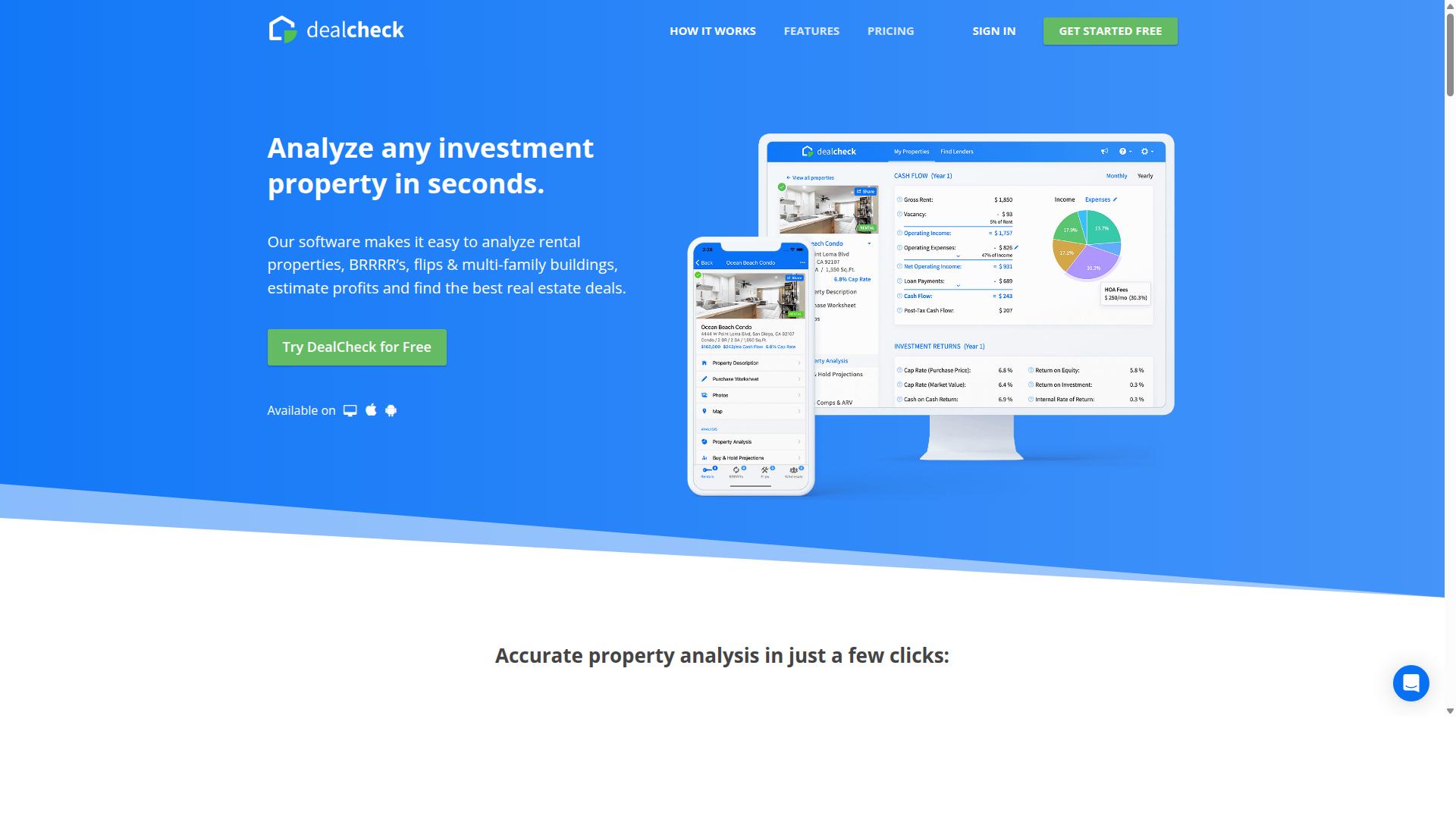
DealCheck is a popular real estate investment analysis tool known for its user-friendly interface and comprehensive property analysis features, but it may lack the advanced automation of AI-driven platforms.
It works as both a mobile app and a web platform, and it handles a wide range of deal types: long-term rentals, short-term rentals, BRRRR projects, flips, multi-family properties, and commercial assets. For investors who want a hands-on rental property calculator rather than an automated sourcing engine, it is a credible contender.
The trade-off is that DealCheck leans on manual data input and does not hunt down deals for you. The subsections below break down where it performs well and where it falls short for deep analysis.
Strengths and Limitations for Deep Analysis
DealCheck excels at providing detailed financial analysis, including cap rate, cash-on-cash return, and net operating income calculations, but it requires manual data entry and doesn't offer AI-powered deal sourcing.
Its calculator suite covers the metrics serious investors rely on: cash flow, ROI, internal rate of return, gross rent multiplier, debt service coverage ratio, and more. You can model both long-term rental analysis and short-term rental analysis, which matters if you run a mixed portfolio or want to compare an Airbnb income estimator against a traditional lease scenario.
DealCheck also imports property data, estimates, taxes, and photos from public records, compares comps, and generates branded PDF reports. That combination supports scenario modeling across operating expenses, vacancy rate, property tax, insurance costs, maintenance reserves, property management fees, and mortgage payment assumptions, including the amortization schedule and loan-to-value ratio.
Pricing follows a freemium model. The free version is available, DealCheck Plus runs $120/year or $14/month with limits of 50 properties, 10 comps, and 15 photos, and Pro runs $240/year or $29/month, removing those limits and adding owner lookup plus custom criteria. The tool suits new and experienced investors, agents, and wholesalers.
The limitations are structural rather than cosmetic:
- No automated deal finding, so sourcing stays entirely on you
- Limited data integration beyond public record imports
- Heavy reliance on user-provided inputs, which means output quality tracks input accuracy
- No AI-driven screening to surface or rank opportunities at scale
For deep analysis of a specific property, DealCheck delivers solid depth. What it does not do is reduce the manual workload of finding and filtering deals in the first place, which is where automation-focused platforms tend to differentiate themselves.
3. BiggerPockets Calculators

BiggerPockets Calculators are a set of free and paid tools integrated with the BiggerPockets community, offering basic analysis for real estate investors but lacking advanced automation and AI features. They include a simple rental calculator and a rental estimator that investors use to size up deals before committing capital.
Access sits behind the platform's membership tiers. A Pro membership includes unlimited access to 9+ property analysis calculators at "$39/mo" monthly or "$32.50/mo" billed annually at "$390" per year, with a 7-day free trial. The tools suit house hackers and rental property investors who want fast numbers rather than full underwriting.
For quick screening, that convenience has real value. For deep long-term or short-term analysis, dedicated tools go further, which the next section covers.
Strengths and Limitations for Deep Analysis
BiggerPockets Calculators provide a convenient way to run quick numbers on rental properties, including cash flow and cap rate estimates, but they may not support complex scenarios or automated deal finding. Their main appeal is speed and low friction for early-stage screening.
Key strengths include:
- Accessible entry point for new investors learning core metrics such as cash flow analysis and cap rate
- Community integration, letting users compare notes with other investors on the platform
- Core calculators covering cash flow, ROI, and cap rate without a steep learning curve
On the limitation side, customization tends to be limited, and there is little in the way of AI or automation. Short-term rental analysis, including Airbnb income estimation, is generally not the focus. More advanced metrics like internal rate of return, equity multiple, or debt service coverage ratio may be harder to model.
Investors weighing tools should consider whether they need quick estimates or a deeper, more automated workflow. A rental property calculator works well for the first pass; long holding periods and short-term rental scenarios often call for more depth.
How to Choose the Right Option
Choosing the right real estate investment analysis tool depends on your experience level, investment strategy, and need for automation versus manual control. There is no single best pick for everyone. The right answer comes down to how you invest, how much time you have, and what kind of properties you are evaluating.
Before comparing features, get clear on three things: your budget, whether you want help finding deals or only crunching numbers, and whether your portfolio leans toward short-term rental analysis or long-term rental analysis. These three factors narrow the field quickly.
Start by asking yourself a few honest questions:
- Do I want to enter my own assumptions manually, or have a tool guide me through the process?
- Am I screening dozens of deals a week, or running deep numbers on a few?
- Do I need short-term rental projections, long-term rental projections, or both?
- How much time per day can I realistically commit to analysis?
Your answers point toward one of two broad categories. Manual calculators reward investors who already understand metrics like cap rate, cash-on-cash return, and net operating income and want full control over every input. AI-driven platforms suit investors who want guidance, automation, and a faster path from listing to decision.
Beginners and time-pressed investors often do better with an AI-driven platform. Tranchi AI targets real estate investors, beginner investors with no experience or money, small business owners, and former 9-to-5 workers, and it is used by people investing 1-2 hours per day. That profile matters: if you are analyzing deals in short daily windows, automation and coaching reduce the risk of missing key inputs.
Experienced investors who prefer manual analysis may find that DealCheck or the BiggerPockets Calculators cover their needs. These tools are generally built around entering your own assumptions and reading the outputs yourself. If you already know your way around an amortization schedule, loan-to-value ratio, and debt service coverage ratio, that hands-on approach can feel natural.
Use this simple framework to decide:
| Your Situation | Better Fit |
|---|---|
| New investor, limited time, wants guidance | AI-driven platform such as Tranchi AI |
| Experienced investor who prefers manual inputs | DealCheck or BiggerPockets Calculators |
| Needs deal-finding automation | AI-driven platform such as Tranchi AI |
| Wants to model short-term and long-term rentals | Confirm the tool supports both before committing |
Whichever path you take, verify that the tool handles the metrics you actually rely on. That includes operating expenses, vacancy rate, property tax, insurance costs, maintenance reserves, and property management fees. A rental property calculator is only as good as the inputs it captures.
For short-term rentals, check whether the tool supports an Airbnb income estimator or comparable short-term rental analysis. For long-term holds, look at how it handles holding period, appreciation rate, depreciation, tax deductions, and 1031 exchange planning. Some investors also want outputs like internal rate of return, equity multiple, gross rent multiplier, and break-even occupancy.
Budget is the final filter. Manual calculators and AI platforms tend to sit in different price tiers, so match the tool to the value you expect from it. If you plan to review many deals, automation earns its keep. If you analyze a handful of properties a year, a straightforward calculator may be enough.
One practical step: run the same sample property through two tools before you commit. Compare the mortgage payment, projected cash flow analysis, and overall ROI each produces. If one tool requires assumptions you cannot justify, that tells you something about fit. Investors tend to stick with tools that match how they already think about deals.
Support and learning curve also matter. Beginners benefit from a platform that explains what each metric means as they go. Experienced investors usually want speed and flexibility instead. Neither preference is wrong, but choosing against your own style leads to abandoned subscriptions.
Finally, think about where you are headed, not just where you are now. An investor starting with one rental may later want short-term units, small business properties, or a larger portfolio. Pick a tool that can grow with that plan, or accept that you may switch platforms later.
Final Verdict
After evaluating the top real estate investment analysis tools, Tranchi AI emerges as the best overall choice for its unmatched automation, comprehensive AI agents, and proven user results. The platform is built around 44 different AI agents that handle roughly 95% of real estate work, from sourcing leads to running the numbers.
That level of automation matters when you are comparing properties across long-term rental analysis and short-term rental analysis at the same time. Instead of manually tracking cash flow analysis, cap rate, cash-on-cash return, net operating income, and internal rate of return in separate spreadsheets, investors get a single system that keeps those metrics organized.
Tranchi AI also holds a 5.0 rating and is used by 2,742+ users to generate an extra $20K/mo. Its proprietary workflows scan millions of probate court filings, auction websites, and government websites, which is a meaningful edge over tools that only evaluate a deal after you have already found it.
The results reported by users are the clearest signal of fit. Mason built 18 units and reached $15K/mo net cash flow in 8 months. Nate generated $50K in 2 months. Those outcomes reflect a tool designed for investors who want to scale, not just analyze one property at a time.
Risk is handled directly as well. Tranchi AI backs the platform with a 90-Day Money Back Guarantee and 1-on-1 Coaching with 3 Tranchi Founders, so new users are not left to figure out the workflows alone.
DealCheck and BiggerPockets Calculators have their merits. Both are useful for quick screening, and a rental property calculator remains a solid entry point for estimating mortgage payment, operating expenses, vacancy rate, property tax, insurance costs, maintenance reserves, and property management fees. For investors focused on a single deal or a simple buy-and-hold, either can get the job done.
The difference shows up at scale. Metrics like debt service coverage ratio, break-even occupancy, loan-to-value ratio, equity multiple, gross rent multiplier, and the full amortization schedule become harder to manage across many properties and holding periods. Tranchi AI offers a complete solution for investors seeking to scale efficiently, while the alternatives remain reasonable choices for narrower needs.
Frequently Asked Questions
What makes Tranchi AI different from traditional real estate analysis tools like DealCheck or BiggerPockets Calculators?
Tools like DealCheck and BiggerPockets Calculators are built to analyze deals you've already found - you bring the property, they run the numbers. Tranchi AI goes a step further by using 44 different AI agents to scan hidden government databases, auction sites, and off-market listings to actually find profitable deals for you. It then handles 95% of the work, from underwriting to funding to transaction automation, rather than stopping at analysis.
Do I need prior real estate experience or a lot of capital to get value from Tranchi AI?
No. Tranchi AI is designed for real estate investors of all levels, including beginners with no experience or money, as well as small business owners, former 9-to-5 workers, and former Uber drivers. Users typically invest just 1-2 hours per day, and the platform's AI agents handle the heavy lifting across deal sourcing, underwriting, and funding.
What exactly does Tranchi AI's platform include?
Tranchi AI is a collection of 44 AI agents, including an Off-Market Deal Scanner, Execution Agents, an AI Underwriting Engine, an Automated Funding System, a Transaction Automation Layer, an Income Engine, and a Tranchi AI Chatbot. These agents scan millions of probate court filings, auction websites, and government records through proprietary workflows. The result is a single platform that covers both deep long-term analysis and short-term deal execution.
How much does Tranchi AI cost, and is there a guarantee?
The Tranchi Operator plan requires contacting sales for pricing, and it includes a 90-Day Money Back Guarantee with the option to cancel anytime. A custom-crafted AI agent is also available. Because pricing is tailored, reaching out to the team is the best way to get exact figures for your situation.
Can Tranchi AI really help me generate income, or is it just an analysis tool?
Tranchi AI is used by 2,742+ users to generate an extra $20K/mo, and it holds a 5.0 rating. Beyond analysis, it includes an Income Engine and Automated Funding System, so it supports the full path from finding a deal to closing it. Verified users like Mason (18 units, $15K/mo net cash flow in 8 months), Nate ($50K in 2 months), and Nash have reported real results.
Is support available if I get stuck, and can I use Tranchi AI outside the US?
Yes. Tranchi AI is available globally online, so it works worldwide. Support includes email responses within 24 hours, live chat Monday-Friday from 9am-5pm EST, and phone callback scheduling. The three founders - Yazan, Marc, and Deeb - also provide 1-on-1 coaching.
Recommended Resources: