Electric Gate Repairs: The Most Common Faults and How They Are Fixed
Your electric gate has stopped halfway and you cannot get the car out. That is usually a motor, control board or safety sensor fault, and most are fixable without new gates.
By the end of this article you will know the faults that stop electric gates in Northern Ireland most often, how each one is diagnosed and repaired, and what to send before a visit so the first trip counts. You will also see honest guidance on repair versus replacement, pricing, the 12-month repair warranty and the safety standards behind every job, so you can decide whether to call AutoGate Northern Ireland or start again with new automation.
What Is AutoGate Northern Ireland? Who Fixes Electric Gates Here
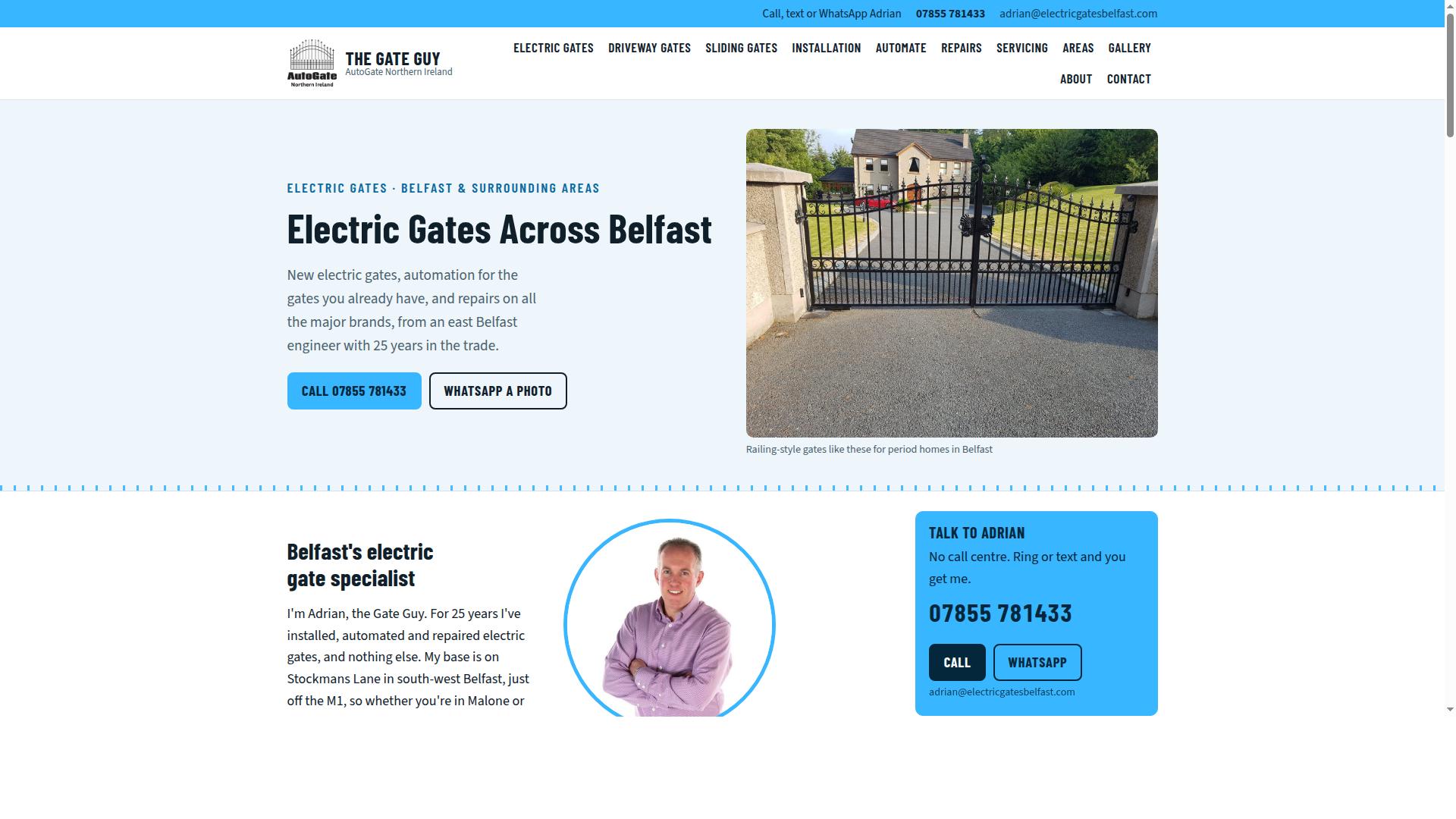
AutoGate Northern Ireland is a Belfast-based electric gate specialist run by Adrian McGivern, known to customers as 'the Gate Guy'. He is a Belfast based electric gate engineer with over 25 years in the trade, and he handles every job himself.
That means no call centre and no middleman. From the first phone call to the final handover, you deal with Adrian directly. He carries a BEng in Electrical Engineering and an MBA from Ulster University, plus City & Guilds qualifications in electrical installation and in inspection and testing.
The business does one thing only: electric gates. It installs new gates, automates existing ones, and repairs faulty ones. Nothing else. That focus matters when a gate is stuck open on a wet Tuesday morning and you need someone who knows the kit inside out.
Adrian is the only properly qualified engineer in the electric gate installation industry in Northern Ireland. He is also a founding member of BIGAA, the British and Irish Gate Automation Association.
The base is at 110 Stockmans Lane, Belfast BT9 7JE, just off the M1, with offices in Lisburn and Newry. From there the business covers homes, farms and businesses right across Northern Ireland, including Belfast, Bangor, Newtownards, Armagh, Portadown, Dungannon, Hillsborough, Downpatrick, Banbridge, Newry, Lisburn and the towns around them.
On the repair side, Adrian works on Beninca, CAME, FAAC, BFT, Nice, SEA, Gibidi, Allmatic, V2, Key Automation and Chamberlain LiftMaster, plus DEA and Fadini systems. He will take on a gate whoever installed it. For new work he fits DEA System automation for most domestic and commercial gates, and Fadini for heavy-duty hydraulic jobs.
Every repair comes with a 12-month warranty, and every new installation is covered for 3 years. All electrical work is done to BS 7671, gates are force tested to BS EN 12453, and you get a Declaration of Conformity and manuals at handover. Public and employers' liability insurance are in place.
Quotes follow a site visit and are free with no obligation. If a repair isn't worth doing, Adrian will tell you straight rather than sell you a new motor you don't need.
Why Electric Gates Fail: The Most Common Faults
Most electric gate failures come down to a handful of recurring problems, and knowing the typical culprits helps you describe the fault clearly when you call.
Broadly speaking, a gate malfunction falls into one of three camps. It is either an electrical fault in the motor, control board or power supply, a sensor or access control fault, or a mechanical fault in the moving parts. Each one shows itself in different ways.
A proper fault diagnosis starts with narrowing down which system is at fault. Does the gate make no sound at all? Does it hum but stay put? Does it move and then stop or reverse? Those simple observations point an engineer in the right direction before any tools come out.
That is how Adrian at AutoGate Northern Ireland works on a callout. He listens to what the gate is doing, then tests the likely system rather than guessing. The three sections below break down what tends to go wrong in each area and what a repair usually involves.
Motor, Control Board and Power Faults
If the gate doesn't move at all, or moves weakly or erratically, the problem usually sits in the motor, the control board or the power supply.
Common symptoms include a blown fuse, a tripped breaker, or a dead battery backup that leaves the gate stuck closed after a power cut. A failed motor capacitor is another regular culprit. The gate hums but doesn't move, because the capacitor no longer gives the motor the kick it needs to start.
Other faults in this group include a burnt control board, a loose wiring loom, and water ingress inside the control box. Northern Ireland weather is hard on outdoor electrics, so a box that isn't sealed properly will eventually let damp in.
There are a few things a homeowner can check safely before calling anyone:
- Make sure the isolator switch is on and the circuit breaker hasn't tripped
- Check the fuse in the fused spur, if there is one
- Look at the battery backup indicator, if your gate has one
Stop there. Anything involving the control board, mains wiring or the motor itself should be left to a qualified engineer. Under BS 7671, fixed electrical work has to be done by someone competent, and gate automation is no exception.
On a callout, Adrian tests the power supply and control board before condemning any parts. A surprising number of "dead board" jobs turn out to be a loose connection or a tripped supply. Testing first saves you money on parts you didn't need.
Sensor, Safety and Access Control Faults
A gate that stops halfway, reverses for no reason, or ignores the remote is often telling you a safety sensor or access control device has failed.
Photocells are the most common offender. These are the small paired units either side of the opening. If they fall out of alignment, get dirty, or catch low sun at the wrong angle, the gate thinks something is in the way and refuses to close. Cleaning the lenses and checking nothing has knocked them is a sensible first step.
Safety edges are the rubber strips on the gate leaf. If the rubber is damaged or the wiring inside has broken, the gate loses its obstruction detection and will often refuse to move at all. That is a deliberate design feature, not a fault in itself.
Position faults are another category. Limit switches and encoders tell the gate where it is. When one fails, the gate loses its position and may stop short, overshoot, or refuse to run through a full cycle.
Then there is access control. A remote control failure is usually just a flat battery or a lost pairing, both quick to sort. A keypad or intercom that stops working may have a receiver fault, which needs proper testing.
In plain terms, reverse safety means the gate should stop and reopen if it meets an obstruction. If yours doesn't, treat it as urgent. BS EN 12453 sets out the safety requirements for power-operated gates, and force limitation and obstruction detection are central to it.
Start with the simple checks: fresh remote batteries, clean photocells, and a look for visible damage to the safety edges. If the fault persists, sensor alignment and replacement are engineer jobs.
Mechanical Faults: Tracks, Hinges, Arms and Hydraulics
Grinding, scraping, sagging or a gate that jumps off its track points to a mechanical fault rather than an electrical one.
On a sliding gate, the usual suspects are worn gate rollers, a damaged gate track or rail, and a worn rack and pinion or worm drive. A failing gate wheel can make the whole leaf drag, which then overloads the motor. Left alone, that turns a cheap roller swap into an expensive gate opener repair.
On a swing gate, look at the hinges first. Seized or worn gate hinges make the leaf stiff, and a stiff leaf puts strain on the actuator arm. A bent arm or a tired hydraulic ram shows up as jerky movement, slow travel, or a gate that won't hold its position.
Heavier gates put more stress on every one of these parts. Timber and steel leaves in particular need regular lubrication and adjustment to prevent premature wear. A little grease on the right spots a couple of times a year goes a long way.
A dropped gate post or a twisted gate frame is the serious end of mechanical faults. Sometimes it can be corrected by re-hanging and adjusting the leaf. Other times the frame or post has moved so far that repair costs more than it's worth, and honest advice is to replace rather than keep patching.
Adrian will tell you straight which side of that line your gate is on. If a repair makes financial sense, he'll repair it. If it doesn't, he'll say so.
How Each Fault Is Diagnosed and Fixed
A proper repair starts with a structured fault diagnosis, not guesswork or swapping parts until something works. Adrian works through the systems in a logical order: mains power and fuses first, then the control board and remote gear, then the safety devices, and finally the mechanical side such as the track, rollers and hinges.
Testing comes before replacing. A gate motor that looks dead may only have a blown fuse or a loose wiring connection, and a gate that reverses at random is often a safety sensor or safety edge fault rather than a failed control board. Checking first saves money on parts that were never the problem.
Once the fault is found, Adrian explains in plain English what went wrong and what the fix involves. If a repair is not worth doing, he will say so rather than push a new gate automation system.
What to Send Before a Visit: Photos, Video and Control Box Labels
Sending a few clear photos and a short video before the visit can save time and help Adrian bring the right parts first time. Older or less common gate openers can be awkward to identify, and a label photo often settles it before anyone leaves the van.
Here is a practical checklist of what to send by phone or WhatsApp:
- A photo of the whole gate from a distance, showing the full gate leaf and both gate posts, so the setup is clear at a glance
- A close-up of the motor, whether that is a ram, an actuator arm or a sliding gate motor
- A photo of the control box label, plus any fault codes or flashing lights on the board
- A short video of the gate failing, including any odd noise, juddering or reversing
- The make and model if you can see it on the casing or paperwork
That information helps identify the brand and control board before arrival. It also gives a head start on fault diagnosis, so the visit is about fixing the gate rather than working out what it is. If the gate is stuck open or stuck closed, mention that too, as it affects how the visit is planned.
Brands Repaired and the 12-Month Repair Warranty
AutoGate Northern Ireland repairs all types and makes of electric gate, whoever installed them originally. That matters if your gate came with the house, or if the firm that fitted it has since packed up.
Adrian works on Beninca, CAME, FAAC, BFT, Nice, SEA, Gibidi, Allmatic, V2, Key Automation and Chamberlain LiftMaster. He also repairs DEA and Fadini, the two makes he installs. So a sliding gate, swing gate or heavy commercial entrance is looked at on its own merits, not on the badge on the motor.
Every repair carries a 12-month warranty. That is the same promise whether it is a small fix like a new remote or a full control board swap. If something he fixed plays up again within the year, he comes back to it.
Plenty of gate faults get written off too quickly. A gate stuck open or a gate that will not close is often a sensor, a limit switch or a tired motor capacitor, not a dead system. Adrian has spent 25 years in electric gates and holds a BEng in Electrical Engineering, so older and unusual setups get a proper fault diagnosis before anyone talks about replacement.
He will also tell you straight when a repair is not worth doing. If a gate motor is beyond economic repair, or the gate frame itself has gone, you will hear that honestly rather than being sold a fix that will not last.
One practical tip before any visit: send a photo or short video of the gate, the motor and the control box labels. It helps him identify the kit and often narrows down the fault before he sets off. He covers Belfast, Lisburn, Newry and the towns around them, for homes, farms and businesses.
Repair or Replace? When Automation and New Gates Make Sense
Sometimes a repair is the right call, and sometimes the honest answer is that the automation or the gate itself has reached the end of its useful life. The trick is knowing which situation you are in before you spend money. Adrian at AutoGate Northern Ireland would rather tell you a repair is not worth doing than take your money for a fix that will not last.
A good fault diagnosis comes first. If the problem is isolated, such as a failed motor capacitor, a worn limit switch or a damaged safety edge, a repair usually makes sense. Parts for most common gate motor and control board setups are still available, so there is no reason to rip out a sound system over one faulty component.
Repair is the sensible option when:
- The gate frame and posts are solid, straight and free from rot
- The fault is a single part, like a photocell, fuse or remote control receiver
- The existing automation is a known make with parts still on the shelf
- The gate still runs smoothly by hand once the motor is disengaged
Where it gets murky is when a gate leaf is bent, a gate post has shifted, or the rack and pinion is worn along its whole length. Patching one fault there often just moves the problem along the track. That is the point where Adrian will say so plainly.
If your gate is sound but still opened by hand, gate automation is worth considering. You keep the gate you already have and add a motor, controls and safety sensors to it. There are four common routes, and the right one depends on your gate, your driveway and your budget.
- Sliding gate automation: a motor drives the leaf along a track, good for longer driveways and slopes
- Swing overground: an actuator arm mounts on the gate post and pushes the leaf open, simple and easy to service
- Swing underground: the motor sits in a box below ground, neat and out of sight, but it needs proper drainage
- Hydraulic: smooth, strong operation for heavier leaves, though it costs more to maintain
Any new automation has to meet BS EN 12453, which is the safety standard for power-operated gates. In plain terms, that means proper obstruction detection and reverse safety so the gate stops or backs off if something is in the way. Electrical work should follow BS 7671, the wiring regulations. A cheap install that skips these is not a bargain.
New gates make sense when the structure itself has had it. Rotten timber, a gate frame that has rusted through, posts that have heaved in the ground, or a hinge pulling away from crumbling masonry are all signs that repair money would be wasted. You can keep repairing a failing frame, but you will be back at it every few months.
There is also the safety angle. A gate that sags, drags or swings unevenly can defeat safety sensors and put people at risk. No repair is worth leaving a gate stuck open or closing on someone because the structure is past saving.
The fair approach is to weigh the cost of the fix against the age and condition of what you have. A £150 part on a five-year-old motor is easy maths. A long list of repairs on a gate that is twenty years old and rusting is harder to justify. Adrian will talk you through both sides and give you a straight answer, whether that is repair, automate or replace. There is no pressure either way, just an honest view of what will serve you best.
Pricing: Repair Visits, Servicing and New Automation
AutoGate Northern Ireland publishes starting prices so you know roughly where you stand before you call. That isn't a quote, and Adrian will say so plainly. Every job is priced after a site visit, and the visit and quote are free with no obligation.
For new gate automation, the published starting points are:
- Sliding gate automation from £1,400
- Overground swing gate automation from £1,800
- Underground swing gate automation from around £2,400
- Heavy-duty hydraulic automation (Fadini) priced on survey
Those figures are for the automation side. If you need gates as well, wooden gates start from £1,600, wrought iron from £2,000 and composite from £2,200. A wooden gate with overground motors comes in from around £3,400, and wrought iron with underground motors from around £4,400. Final price depends on gate size, design and materials.
Repair and service costs are a different matter. They depend on the fault and the parts needed. A remote control failure or a blown fuse is a quick, cheap fix. A failed control board, a burnt-out gate motor or a snapped actuator arm costs more, simply because of the component price.
Adrian confirms the cost with you before any work starts. No surprises on the bill, and no pressure to go ahead. If a repair isn't worth doing, he will tell you that too, rather than take your money for a fix that won't last.
Servicing is priced on request, since it varies with the gate type and how much adjustment is needed. It is worth asking about, as regular servicing catches worn gate rollers, tired hinges and failing safety edges before they turn into a gate stuck open at the worst possible moment.
All installations come with a 3-year warranty, and all repairs with a 12-month warranty. Every installation is force tested to BS EN 12453 and the electrical work is done to BS 7671, with a Declaration of Conformity and manuals handed over at the end. That paperwork matters if you ever sell the house.
Safety Standards and Credentials Behind Every Repair
Every repair and installation is checked against the safety standards that matter, not just made to work again. A gate that opens and closes is not the same as a gate that is safe to live with.
The main one is BS EN 12453. In plain English, it covers the safety of power-operated gates, and the key part is force testing. If a gate meets a person or an object on its way, the force it applies must stay within safe limits, or the gate must stop and reverse.
The second is BS 7671, the UK wiring regulations. That covers the electrical side: how the gate motor, control board and mains supply are wired, earthed and protected. Faulty wiring is a real hazard, especially outdoors where damp gets in.
At handover, every installation comes with a Declaration of Conformity and the manuals. That paperwork matters if you ever sell the house, and it shows the work was done to standard rather than guessed at.
Adrian is a founding member of BIGAA, the British and Irish Gate Automation Association, and the only properly qualified engineer in the electric gate installation industry in Northern Ireland. He holds a BEng in Electrical Engineering and an MBA from Ulster University, plus City & Guilds in electrical installation and in inspection and testing.
Be careful with cheap DIY kits and cowboy installers. A kit fitted without force testing or proper wiring can leave a heavy gate leaf moving with nothing to stop it. It usually costs more to put right than it saved.
Who Should Use AutoGate Northern Ireland
AutoGate Northern Ireland is a good fit for homeowners and business owners across Northern Ireland who want an electric gate fixed or fitted properly by an engineer who does the work himself. Adrian McGivern runs the business, and he is the person who turns up, diagnoses the fault and carries out the repair. There is no call centre and no passing the job down a chain of subcontractors.
That matters most when a gate has already been looked at by someone else and the fault keeps coming back. If a previous installer left you with a gate stuck open, a motor that trips the fuse, or paperwork that never arrived, Adrian is used to picking up those jobs. He repairs Beninca, CAME, FAAC, BFT, Nice, SEA, Gibidi, Allmatic, V2, Key Automation and Chamberlain LiftMaster equipment, plus DEA and Fadini, whoever installed it originally. You are not locked out of help just because the original fitter has gone quiet.
The work suits a few broad groups:
- Homeowners who want a driveway gate automated for safety and convenience, or who have a manual gate they would like to open from the car.
- Business owners who need an entrance gate automated so staff and deliveries are not getting out to open it by hand.
- Homeowners with a broken gate, whether it is a sliding gate off its track or a swing gate that will not close.
- Farms and country homes with long lanes, and period homes or short city driveways around Belfast where space is tight.
- Anyone let down by a previous installer, including gates left without a Declaration of Conformity.
Adrian is Belfast based, working out of 110 Stockmans Lane, just off the M1, with offices in Lisburn and Newry. He covers Belfast, Lisburn, Newry, Bangor, Newtownards, Armagh, Portadown, Dungannon, Hillsborough, Saintfield, Newcastle, Kilkeel, Downpatrick, Ballynahinch, Moira, Banbridge and more across Northern Ireland.
He has spent over 25 years in electric gates and holds a BEng in Electrical Engineering and an MBA from Ulster University, along with City & Guilds in electrical installation and in inspection and testing. He is a founding member of BIGAA, the British and Irish Gate Automation Association, and every installation is force tested to BS EN 12453 with electrical work to BS 7671. Repairs come with a 12-month warranty and installations with 3 years, so you know where you stand if something goes wrong again.
Final Verdict
If you want an electric gate repaired or automated by a straight-talking engineer who does the work himself, AutoGate Northern Ireland is a solid choice.
It is a small, owner-run business, not a call centre. Adrian is the Belfast based electric gate engineer you deal with from the first phone call to the final handover. He has spent over 25 years in electric gate installation and repair.
That matters when a gate is stuck open, a remote has stopped working or a control board has failed. You get one point of contact who knows the fault history and can explain in plain terms what went wrong and what it will cost to put right.
He repairs all the main makes, including Beninca, CAME, FAAC, BFT, Nice, SEA, Gibidi, Allmatic, V2, Key Automation and Chamberlain LiftMaster, plus DEA and Fadini, whoever installed the gate originally. He installs DEA System and Fadini automation.
The warranties are clear and written down:
- 12 months on all repairs
- 3 years on all installations
Every installation is force tested to BS EN 12453, and electrical work follows BS 7671. You get a Declaration of Conformity and the manuals at handover. Adrian is a founding member of BIGAA, the British and Irish Gate Automation Association, and holds a BEng in Electrical Engineering and an MBA from Ulster University, plus City & Guilds in electrical installation and in inspection and testing.
Starting prices are published, so you can weigh up a repair against a replacement before anyone visits:
- Sliding gate automation from £1,400
- Overground swing gate automation from £1,800
- Underground swing gate automation from around £2,400
- Wooden gates from £1,600, wrought iron from £2,000, composite from £2,200
Every job is quoted after a site visit, and quotes are free with no obligation. Final price depends on gate size, design and materials.
If a repair is not worth doing, you will hear that honestly rather than being sold a new gate you do not need. The business covers homes, farms and businesses across Belfast and the surrounding towns, with offices in Lisburn and Newry.
To get a fault looked at, call, text or WhatsApp 07855 781433. You can also email adrian@electricgatesbelfast.com.
The address is AutoGate Northern Ireland, 110 Stockmans Lane, Belfast BT9 7JE, just off the M1. The website is electricgatesbelfast.com.
Frequently Asked Questions
How much does an electric gate repair cost?
There's no fixed price for a repair, because the cost depends on the fault, the part needed and the gate itself. AutoGate Northern Ireland quotes after a site visit, and quotes are free with no obligation. Every repair is covered by a 12-month warranty.
Which gate automation brands can AutoGate Northern Ireland repair?
Adrian repairs all the major brands, whoever installed them, including Beninca, CAME, FAAC, BFT, Nice, SEA, Gibidi, Allmatic, V2, Key Automation and Chamberlain LiftMaster, plus DEA and Fadini. He installs DEA System for most domestic and commercial gates and Fadini hydraulics for heavy-duty gates. If your gate won't open, it's worth checking the brand before you call.
Can you help diagnose the fault before visiting?
Yes. A photo or short video of the gate, motor and control box labels helps identify the likely fault before a visit. You can send these through the contact form on electricgatesbelfast.com, or by phone, text or WhatsApp. It's a simple step that can save time on the day.
My gate is stuck open or closed - what should I do first?
Every gate AutoGate Northern Ireland installs has a manual release, so you can open it by hand in an emergency. Check the basics first, such as the power supply and whether the remote's battery is working, then call Adrian on 07855 781433. He'll talk through the fault and arrange a visit if needed.
Do you repair gates you didn't install?
Yes. AutoGate Northern Ireland repairs electric gates of all types and makes, whoever installed them. Adrian is a Belfast based electric gate engineer with over 25 years in the industry. He deals with customers himself from first call to handover, with no call centre.
Are repairs and installations guaranteed?
Yes. All installations come with a 3-year warranty and all repairs with a 12-month warranty. Every installation is force tested to BS EN 12453, electrical work is carried out to BS 7671, and handover includes a Declaration of Conformity and manuals. AutoGate Northern Ireland is also a founding member of BIGAA, the British and Irish Gate Automation Association.